
· by Michael Blair, Nashville's Garage Floor
The question comes up in fall and winter, when cars roll in wet from the rain, the dog tracks in soggy leaves, and the step down from the kitchen door is where everyone crosses. Bare concrete has a naturally rough surface. A coating fills that texture and puts a smooth, glossy film on top, and a smooth film under a thin layer of water is slicker than the concrete ever was. How much slicker depends almost entirely on decisions made during installation.
Why a wet coating loses grip
Grip on any floor comes from texture that pokes through the water film so a shoe sole or a tire tread can touch the surface. Concrete has that texture everywhere. A high-build coating, especially one rolled smooth under a thick clear topcoat, has almost none, so water sits as a continuous sheet and a smooth-soled shoe skates on it. Dry, the same floor is perfectly sure-footed.
Oil makes it worse. A drip of motor oil or power steering fluid on bare concrete soaks in. On a coated floor it stays on top as a slick patch until somebody wipes it up. That is the other side of a floor that does not absorb stains: whatever lands on it stays exactly where it fell.
What the installer controls
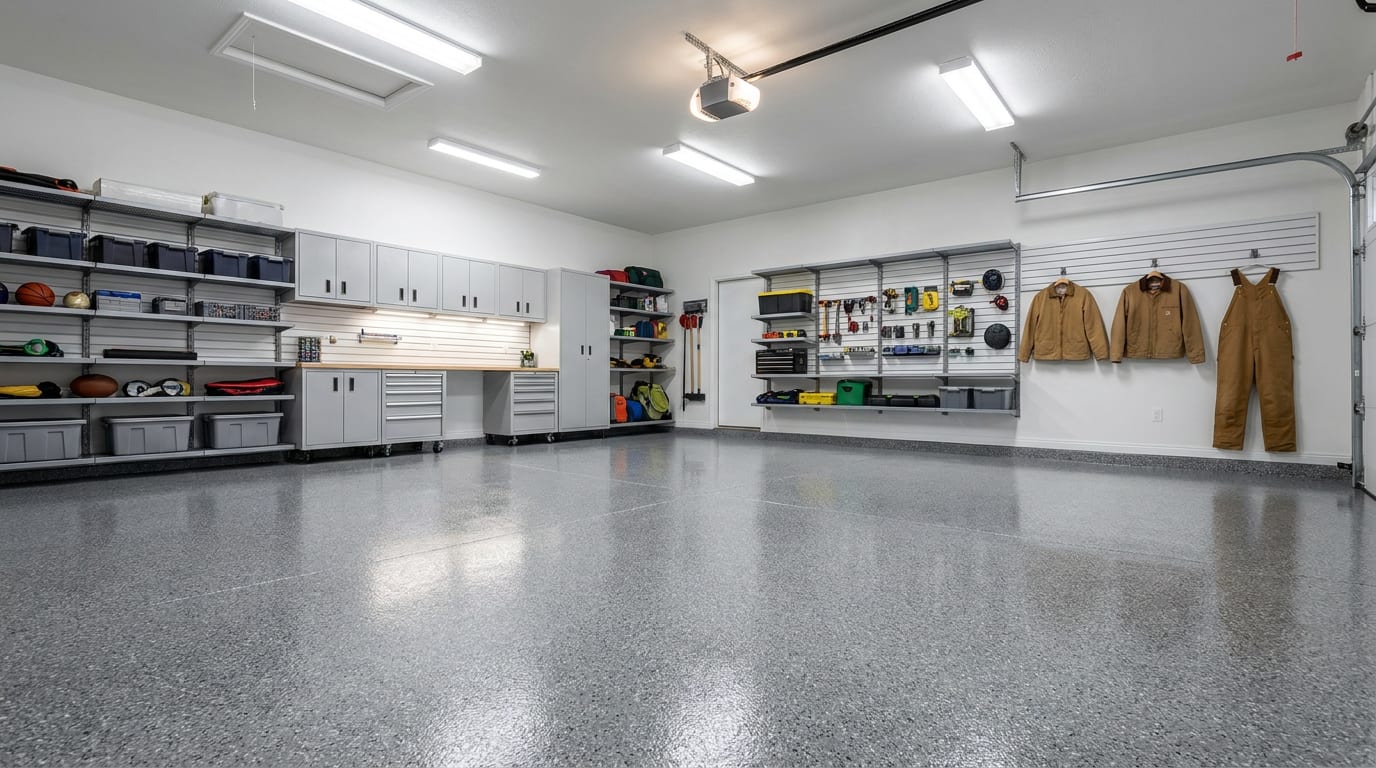
The flake broadcast is the main lever. In a full-flake system, vinyl chips are thrown into the wet base coat until it will not hold any more, the loose excess is scraped off once it cures, and a clear topcoat goes over. The edges of those chips give texture under the topcoat. A thinner topcoat leaves more of it showing; a heavy one buries it, and the floor gets smoother and glossier.
For more grip, an anti-slip additive goes into the topcoat, usually a fine aluminum oxide grit or polymer beads. It gives the surface a light sandpaper feel. More grit means more traction and a floor that is harder to mop, because the texture holds fine dirt, so the usual approach is a moderate amount across the floor and more on the walk paths and the step down from the house.
- Full flake broadcast, with a topcoat that does not bury the texture
- Grit additive in the topcoat, heavier where people walk
- Extra texture on steps, ramps and the apron edge
- Solid-color systems with no flake, which need grit more than any other
Fixing a floor that is already slick
A coating in good condition can take a new textured topcoat. The old topcoat is abraded, usually with a floor machine and a sanding screen, cleaned thoroughly, and a fresh coat with grit mixed in is rolled over it. The new coat bonds to the scuffed surface of the old one, so the floor beneath has to be sound. If the existing coating is lifting at the door or around the drain, another layer just adds weight to a failing bond.
Short of recoating, rubber-backed mats at the house door and under the front of each car catch most of the water before it spreads. Adhesive anti-slip treads on the garage steps help where people step down in socks or slippers. A floor squeegee kept by the door pushes a puddle out to the apron in under a minute.
Living with it through the wet months
Late fall in Middle Tennessee brings days of steady rain, and a car that comes in wet drips a puddle under each wheel well for an hour. Leaves stick to tires and ride in with them, and a wet oak leaf on a smooth coating is about as slippery as ice. Blowing the apron and the driveway edge clear during leaf drop cuts down how many make it inside.
The floor itself asks for very little. Sweep it, mop it with a pH-neutral cleaner, and skip soap-heavy products that leave a film, because a soap film on a coated floor is slick even when it looks dry. Harsh degreasers and citrus cleaners can dull some topcoats. The coating manufacturer usually names what to use, and the installer should be able to hand you that sheet.