
· by Michael Blair, Nashville's Garage Floor
Search for a garage coating in Nashville and you will see polyurea and polyaspartic used as if they were the same product, sometimes on the same quote. They are related, and the overlap is real, but they are not interchangeable. Each has a place in a flake floor, and putting the wrong one in the wrong place shows up a year or two later as a floor that has turned amber where the sun hits it. Here is how the two fit together on the floors our polyaspartic coatings page describes, and what to ask any installer who quotes you either one.
The same family, a different starting material
Both are urea chemistry: a resin reacting with an isocyanate to form a hard, tough film. The difference is which isocyanate. Covestro, the company that makes polyaspartic resins, puts it plainly in its article on high-solids and solvent-free coating systems: polyaspartic coatings come from an aliphatic polyisocyanate reacting with a polyaspartic ester, and the result is an aliphatic polyurea. The same page says those coatings differ greatly from conventional polyureas, which are built on aromatic polyisocyanates.
So polyaspartic is, strictly speaking, one kind of polyurea. When a floor company says polyurea on its own, it usually means the conventional, aromatic kind. That distinction, aliphatic against aromatic, is the whole story for a garage owner. It decides how the material holds its color in daylight, how long the crew has to work it, and which layer of the floor it belongs in.
Where each one goes in a flake floor
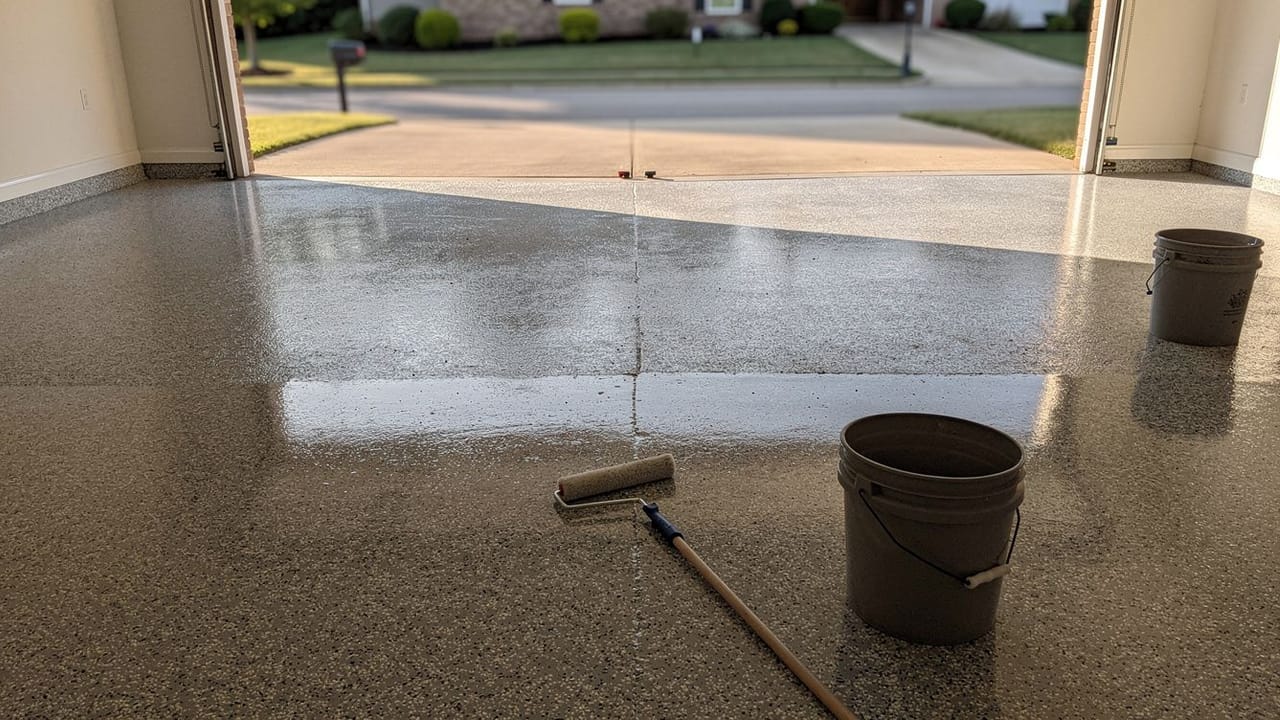
A full-flake floor is three layers on a ground slab: a basecoat, a broadcast of vinyl chips into that basecoat while it is wet, and a clear topcoat over everything. Simiron’s system guide for its one-day polyurea flake floor is a good example of how the two materials divide the work. Its polyurea goes down as the basecoat, a quarter-inch vinyl chip is broadcast into it, and a polyaspartic goes on top as the clear coat.
The guide is direct about why the polyurea stays underneath. It says to apply that polyurea only as a primer or basecoat, because the product will yellow over time, and any spot the flake does not cover will discolor. Under a full broadcast the chips hide the basecoat, so its color never matters. Rolled on as the final coat, it would be the first thing the afternoon sun through the door reached.
The topcoat has the opposite job. Simiron’s Polyaspartic HS data sheet calls it a two-component aliphatic polyaspartic, and reports a gloss reading of 87 to 89 after 1,000 hours of accelerated UV exposure under ASTM G154. The same sheet says not to use it as the topcoat on a smooth floor; it is designed to go over full broadcast systems. That is the floor described on our full-flake and quartz systems page: chips to the edges, then the clear coat.
- Ground slab, with cracks and spalls repaired
- Basecoat: polyurea or epoxy, tinted, never left exposed
- Vinyl flake broadcast to rejection, then scraped and vacuumed
- Topcoat: clear aliphatic polyaspartic over the flake
Working time in a Middle Tennessee garage
Fast chemistry is the reason a flake floor can be finished in a day, and it is also what makes it unforgiving. Simiron’s system guide says not to mix more of its polyurea basecoat than can be applied and broadcast within 15 minutes. That is the time between opening the activator and having flake landing in it, so the floor is done in sections, mixed in small batches, with the flake thrown by a second person right behind the roller.
The polyaspartic topcoat gives more room, and how much depends on the cure speed chosen and the weather in the garage. The Polyaspartic HS sheet lists, at 72°F and 80 percent humidity, a working time from 14 minutes for its fast version to 70 minutes for its extra-slow one. At 72°F and 20 percent humidity, the same products run from 25 minutes up to two hours. The sheet adds that higher temperatures and humidity shorten pot life and working time. A closed garage in a Nashville July is exactly that condition, which is why we pick the slower cures in summer and mix to the size of the section, not the size of the floor.
Cold works the other way. The system guide calls for the slab to be at least five degrees above the dew point, and for the fast-cure topcoat when the floor is below 60°F. Our post on coating a garage floor in cold weather covers what that means between November and March. Either way, the sheet’s heavy-traffic timing for most of its cure speeds, 24 hours, assumes at least 72°F and 50 percent humidity, and it takes longer if either is lower.
What to ask before you sign
Two questions sort out most quotes. First, what is the topcoat, and is it an aliphatic polyaspartic? If the answer is a polyurea topcoat, ask which kind, because the conventional aromatic material is the one that discolors. Second, what is under the flake? A polyurea basecoat and an epoxy basecoat both work under a full broadcast. They differ mostly in how fast the floor goes down and how the base handles the slab. Our post on epoxy or polyaspartic for a garage floor covers the epoxy side of that choice.
Then ask about the slab, because no chemistry fixes a bad one. The system guide calls for the concrete to be ground or shotblasted to at least a CSP 3 profile, for new concrete to cure at least 28 days, and for moisture to be within limits: vapor emission no higher than three pounds per 1,000 square feet in 24 hours under ASTM F1869, or relative humidity in the slab no higher than 75 percent under ASTM F2170. Many older garage slabs in Davidson County were poured without a vapor barrier under them, and the guide notes that seasonal ground moisture can still push vapor up through a slab that tested fine. It also warns that its polyurea should not be used to fill joints or deep cracks, because it can foam and swell there. That is grinding and repair work, which our diamond grinding page describes.
Last, ask about tires. Both Simiron sheets say tire marking may occur, and the system guide suggests a small piece of sheet metal or plexiglass between the tires and the floor where a car sits every day. That is honest, and it is worth hearing from an installer before the floor goes down rather than after. If you are weighing a polyurea or polyaspartic floor in Nashville and the rest of Davidson County, ask us for a free estimate. We grind a test area, take moisture readings, and tell you which basecoat and which topcoat cure we would use on your slab, and why.
Sources
- Covestro, High solids and nonsolvent systems — Polyaspartic as an aliphatic polyurea; conventional polyureas built on aromatic polyisocyanates
- Simiron, Simflake SB 1-Day Polyurea System Guide (2024) — Polyurea basecoat only, yellowing, 15-minute batches, dew point and cold-weather topcoat, slab prep and moisture limits, tire marking
- Simiron, Polyaspartic HS Product Data Sheet (2026) — Aliphatic polyaspartic topcoat, ASTM G154 gloss retention, working times by cure speed, traffic timing, for full broadcast systems only