
· by Michael Blair, Nashville's Garage Floor
People who search for concrete polishing in Nashville are often looking at three different finishes under one name. Polished concrete, grind-and-seal and a coated floor all begin the same way, with a diamond grinder taking the top off a bare slab, and from a distance they can look alike in a showroom photo. They are not the same work, they do not suit the same rooms, and they ask different things of the concrete underneath. Choosing well starts with knowing which one you are actually being quoted.
Three finishes that start with the same grinder
Polished concrete is the slab itself, refined. The ASCC Concrete Polishing Council’s glossary defines it as a multi-step operation of grinding, honing and polishing the floor with bonded abrasives, and it separates that from burnishing, which is friction-rubbing the surface, with or without waxes or resins, to raise a shine. Partway through the grinding, a densifier goes on. The same glossary describes it as silicate and water-based compounds that react in the surface of the concrete, hardening the top layer so it takes a polish. A penetrating guard that does not form a film usually goes on last. The council’s guide to specifying classes and levels sets three classes of aggregate exposure and four sheen levels, so a polished floor can be ordered from a cream finish with little stone showing up to a high reflective gloss.
Grind-and-seal stops much earlier. Our crews grind the slab to open and level the surface, take out the old paint, mastic or contamination, clean up every bit of dust, and roll on a clear sealer. The concrete stays the finish, with its color, patches and trowel marks intact, but there is no honing and polishing sequence behind it, so it reads as clean, sealed concrete rather than a polished floor.
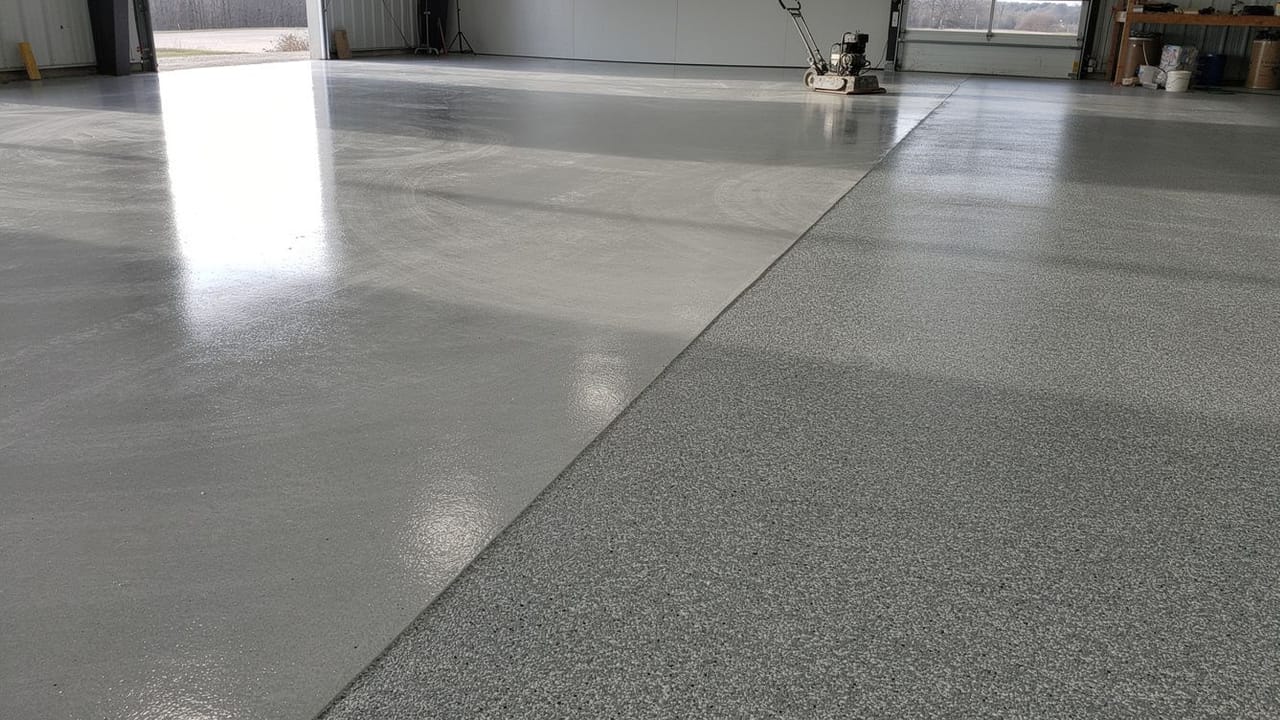
A coating covers the slab. The grinding is there only to give the coating something to bond to, and then a base coat, usually a flake broadcast, and a topcoat build a new surface on top. Which chemistry goes on is its own decision, covered in our post on epoxy or polyaspartic for a garage floor.
How each one goes down
On a polished floor, the densifier timing matters. The PROSOCO data sheet for Consolideck Blended Densifier calls for grinding to a 200-grit resin bond, removing the dust, letting the floor dry, and applying a single saturating coat to a surface that is clean, dry and absorbent, between 40 and 100°F, then allowing at least an hour to dry before the work goes on. After that come the finer resin grits, as many as it takes to reach the sheen that was ordered, and then the guard.
Grind-and-seal and a coating both rely on the same first step, which is the part of the job our diamond grinding and repair page describes: grinding away the weak surface layer, cutting out and filling cracks and spalls, and vacuuming the slab clean. For grind-and-seal the sealer follows right behind. For a coating, the patches cure, the base coat goes on, and the floor is built up in layers.
- Polished: grind, densify, hone and polish through finer grits, guard
- Grind-and-seal: grind, repair, clean, clear sealer
- Coating: grind to a profile, repair, base coat, flake, topcoat
What the slab has to be like first
A coating hides the concrete. Polishing puts it on display, and that is the hard part. An article in Construction Specifier, hosted by ASCC, on specifying a slab to be polished, says plainly that concrete suitable for many flooring materials is usually unsuitable for polishing. It points out that areas finished by hand near edges and penetrations end up with a different surface density than the slab a power trowel finished, and that polishing exposes the difference. In a garage, that is the strip along every wall, the area around the floor drain and the threshold at the house door. The article recommends a mockup of about 400 square feet before a commercial polish is approved. On an existing house slab we grind a test area for the same reason, so you see what the concrete will look like before you commit to it.
Moisture is the other question, and it is measured, not guessed. ASTM F2170 is the test for relative humidity inside a concrete slab: probes set in drilled holes. The standard notes that excess moisture can cause debonding, peaking, deterioration of finishes and microbial growth, and that manufacturers generally require moisture testing before installation. It does not set a limit itself; the product does. One example is the Sikafloor-2570 WB data sheet, which requires F2170 readings at or below 85 percent and calls for a moisture-mitigating primer when they fall above 85 but below 96. A polished floor is different because nothing sits on top of it, and the PROSOCO PolishGuard data sheet describes that guard as breathable, so it does not trap moisture. The densifier still has to go on a dry slab, though, and a slab that tests wet changes which of the three finishes is worth doing.
Where each belongs, and how it holds up
A garage takes tire traffic, dripping cars, dropped tools and whatever comes off the road in winter, and a full-flake coating is built for that. A basement or a finished room that will see bare feet and furniture, not cars, is where polished concrete makes the most sense, as long as the slab tests dry and the hand-troweled edges are acceptable once exposed. Grind-and-seal suits a shop, a storage room or a utility space where the goal is a clean, sealed slab that is easy to sweep and nobody is after a showpiece. Warehouses, showrooms and service bays each lean one way or another, and our shop and commercial floors page goes through how we decide.
For grip, the Tile Council of North America’s DCOF FAQ explains that ANSI A326.3 is a hard surface flooring standard, not a tile-only one, and that a wet dynamic coefficient of friction of at least 0.42 is the criterion for level interior floors walked on when wet. It also says the number does not predict whether a given person will slip. Ask for a tested value on the specific finish rather than a promise. In a workplace, OSHA 29 CFR 1910.22 requires floors kept clean and, as far as feasible, dry and free of spills, snow and ice, and it sets no friction number, so a shop floor stays safe through housekeeping as much as through the finish.
Stains and upkeep differ too. PROSOCO notes that its densifier improves stain resistance, that acids and acidic foods may etch the floor, and that it will not stop water passing through structural cracks or open joints. The guard raises stain resistance on interior floors and keeps slip resistance, but acidic spills can still etch and stain. So a polished floor is dust-mopped, cleaned with a neutral cleaner, spills are wiped up instead of left overnight, and the guard is renewed when the shine dulls in the traffic lanes. A grind-and-seal floor is resealed when water stops beading where people walk. A coating is swept and mopped and recoated with a fresh topcoat when the wear lanes show. When you want to see which of the three your slab is suited to, ask us for a free estimate and we will grind a test patch and take the moisture readings before quoting.
Sources
- ASCC Concrete Polishing Council, Glossary — Definitions of polished concrete, burnishing, densifier and penetrating stain protection
- ASCC, How to Use CPC Classes and Levels to Specify Polished Concrete (2024) — Three aggregate exposure classes and four sheen levels
- Construction Specifier, Specifying the Concrete Slab to be Polished (hosted by ASCC) — Slab suitability for polishing, hand-finished edges, mockup size
- PROSOCO, Consolideck Blended Densifier Product Data Sheet — When and how densifier is applied, stain resistance, etching by acids
- PROSOCO, Consolideck PolishGuard Product Data Sheet — Guard stain resistance, slip resistance, breathability
- ASTM F2170, relative humidity in concrete slabs — In-slab RH test and why manufacturers require it
- Sika USA, Sikafloor-2570 WB Product Data Sheet — Example coating RH limit and mitigation threshold
- Tile Council of North America, DCOF FAQ — ANSI A326.3 scope and the 0.42 wet DCOF criterion
- OSHA, 29 CFR 1910.22 General requirements — Workplace floors kept clean and dry; no friction value set