
· by Michael Blair, Nashville's Garage Floor
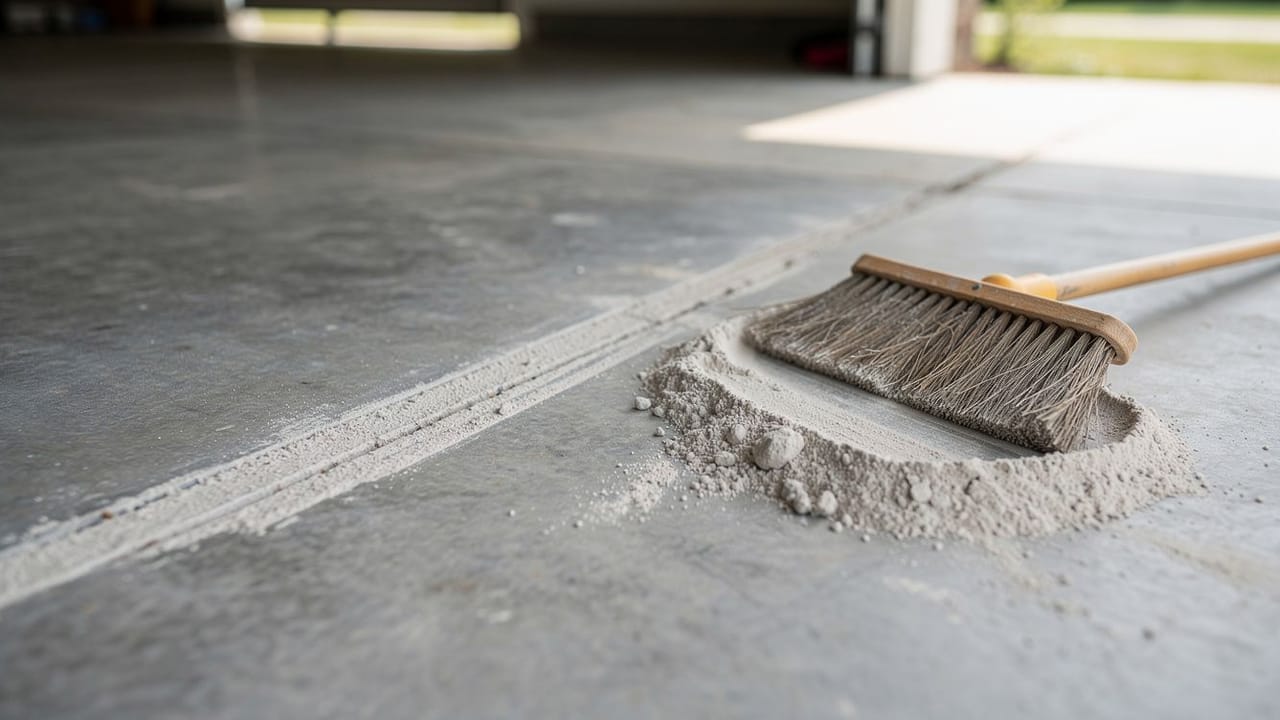
Sweep the garage on Saturday and by the next weekend there is a fine gray film on the floor again, tracked into the house on shoes and settling on everything stored near the ground. That powder is not dirt blowing in. It is the surface of the slab itself coming apart a little at a time. The trade calls it dusting, and it matters twice over in a garage: once because of the mess, and again if you plan to coat the floor, because a coating bonds to whatever is on top. Here is what causes it, how to tell if your floor has it, and how our diamond grinding and repair work deals with it.
What is concrete dusting?
Concrete dusting is a soft top layer on a hardened slab that turns to powder under use. The National Ready Mixed Concrete Association defines it in its Concrete in Practice sheet on dusting surfaces as loose powder formed when the surface of hardened concrete disintegrates. The same sheet says such a surface powders under any kind of traffic and can be scratched easily with a nail, or even by sweeping.
That gives you a simple test before anyone quotes the floor. Drag a nail or the tip of a key across a clean, dry patch of the slab, in a spot away from the door where the floor sees the least wear. Sound concrete takes a faint line. A dusting floor gives up a groove of powder, and running a finger across the floor afterward leaves it gray. If the whole garage does this, the weakness is in the slab’s top layer, not in a coating or a spill.
Why does a garage slab start to dust?
Most dusting traces back to the day the slab was poured and the week after. The NRMCA sheet names the main cause as finishing while bleed water is still on the surface. Working that water back into roughly the top quarter inch of the slab gives it a very high water-cement ratio, and the result is a low-strength skin over otherwise good concrete.
The sheet lists other ways to end up with the same weak layer:
- Dry cement scattered on the surface, or water sprinkled on, to make finishing easier
- Troweling after moisture condenses on cold concrete from warm, humid air
- Carbon dioxide from open heaters, gasoline engines or generators running in an unvented space while the concrete is fresh
- Too little curing, or freezing, rain or drying wind on the new surface
- Placing the concrete directly on plastic sheeting or another base that does not absorb water, which leaves more bleed water at the top
How do you fix a dusting garage floor?
The fix is to remove the weak layer first and then treat or cover what is underneath. The NRMCA sheet calls for sandblasting, shot blasting or a high-pressure washer to take off the soft surface, then a chemical hardener such as sodium silicate or a zinc or magnesium fluosilicate on the dried concrete. It adds that if dusting continues, a coating such as an epoxy sealer, a latex formulation or cement paint is the next step, and that in severe cases the slab is wet-ground down to durable concrete and given a bonded topping.
We take the weak layer off with diamond grinding, a mechanical method that cuts down to sound concrete and leaves an open surface a coating can grip. Grinding also shows how deep the soft layer goes, which is not something anyone can judge from the broom. In most garages the powder is a thin skin; where the grinder keeps finding weak material, the floor needs more than a sealer, and we say so in the estimate. Brushing on a clear sealer over a dusting floor without that step only glues the powder down for a while.
Can an epoxy or polyaspartic coating go over a dusty floor?
Only after the dusting layer is gone, because the coating is only as strong as the concrete it sticks to. Coating makers write that into their instructions. Sika’s product page for Sikafloor-165 FS, a floor primer and binder, asks for concrete of at least 3,625 psi in compression and a pull-off strength of at least 218 psi in tension when the product is applied. It also calls for laitance and dust to be removed and for the surface to be opened by shot blasting or equivalent mechanical means to a CSP-3 to CSP-4 profile under ICRI guidelines. Those numbers belong to that one product, but the point holds for every system: a soft surface fails the bond test before any resin is mixed.
Put a coating straight onto a dusting slab and the failure usually shows up as flakes of coating lifting with a thin gray crust stuck to their underside. That is concrete, not glue, and it is one of the causes covered in our post on why garage floor coatings peel off. Once the floor is ground to sound concrete, the choice between an epoxy floor coating and a polyaspartic system comes down to the same things it would on any garage.
If your garage leaves gray powder on the broom every week, ask us for a written estimate. We will test the surface, tell you how deep the problem looks, and lay out the grinding and the system in writing before anything goes down.
Sources
- NRMCA, CIP 1: Dusting Concrete Surfaces — Definition of dusting, the nail and sweeping test, causes (bleed water, condensation, carbonation, curing, non-absorptive base), and repair by blasting, hardeners, coatings or grinding and topping
- Sika USA, Sikafloor-165 FS product page — Substrate requirements for one coating product: 3,625 psi compressive, 218 psi pull-off, laitance and dust removed, CSP-3 to CSP-4 by mechanical preparation
FAQ
Why a Concrete Garage Floor Keeps Shedding Dust — questions
What is concrete dusting?
Concrete dusting is a soft surface layer on a hardened slab that wears into fine gray powder under foot traffic, tires and even a broom. It usually comes from how the slab was finished or cured when it was poured. The concrete below that thin layer is often sound, which is why the fix starts with removing the top.
How do you test a garage floor for dusting?
Pick a clean, dry spot and drag a nail or the tip of a key across it. Sound concrete shows a faint line. A dusting slab gives up a groove of loose powder, and a finger run across the surface comes away gray. If the whole floor behaves that way, the weakness is in the slab itself.
How do you fix concrete dusting?
Remove the weak surface layer first, by blasting, pressure washing or, as we do, diamond grinding down to sound concrete. After that the slab can take a chemical hardener such as sodium silicate, or a coating. In severe cases the slab is ground deeper and given a bonded topping. Sealing over the powder without removing it does not last.
Can you epoxy a dusty garage floor?
Yes, but only once the dusting layer has been ground off. Epoxy bonds to the top of the slab, and if that top is weak, the coating lifts with a crust of concrete stuck to its underside. Coating makers ask for clean, sound concrete with laitance and dust removed and a mechanically opened surface before anything is applied.
Why is my concrete garage floor dusty?
Most often because the slab was finished while bleed water sat on the surface, which left a weak, watery top layer. Other causes are short curing, troweling after condensation formed on cold concrete, exhaust from heaters or engines in a closed space while the concrete was fresh, and pouring directly onto plastic sheeting.