
· by Michael Blair, Nashville's Garage Floor
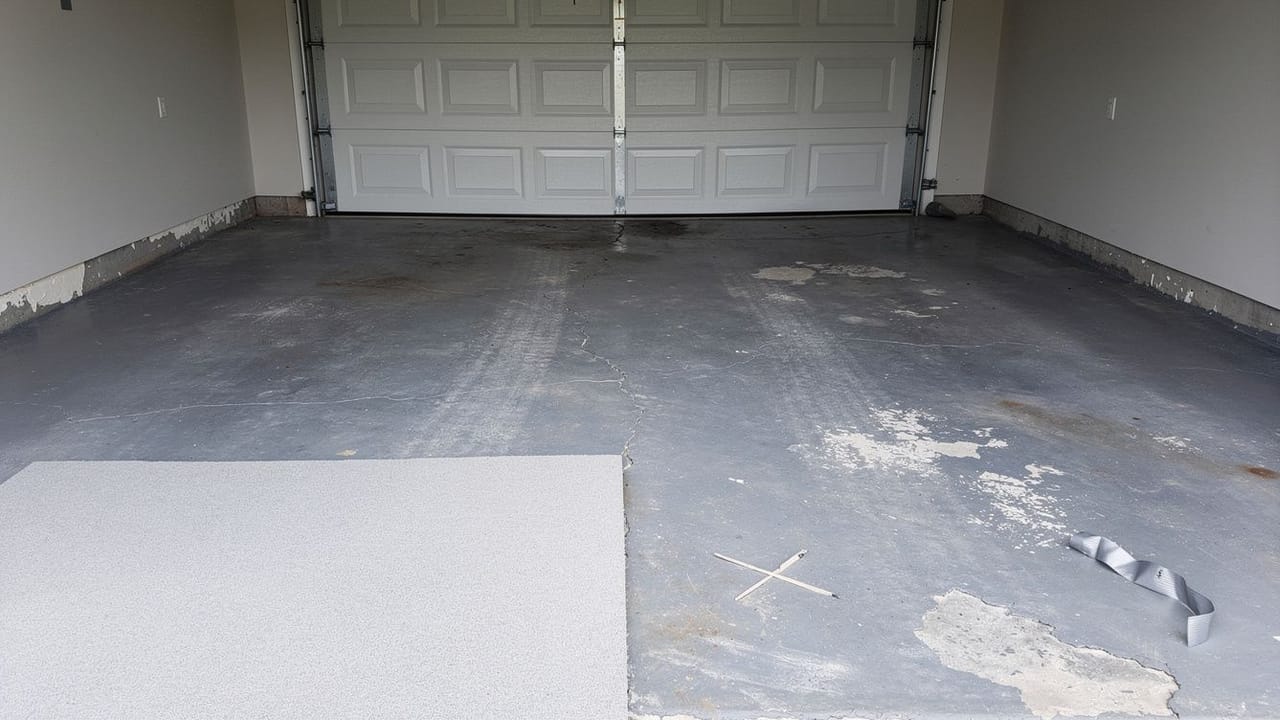
A lot of garage floors around Nashville were painted once, by a builder or a past owner, with a one-part floor paint from a can. By the time anyone wants a real coating, that paint has worn through in the tire lanes and is lifting at the edges. The question is whether the new coating can go right over it.
The coating makers answer it in their data sheets, and the short version is that the new layer is only as well attached as whatever it sits on.
Can you put epoxy over a painted garage floor?
Only over paint that is still tightly bonded to the concrete, and only after it has been sanded. Rust-Oleum’s EpoxyShield technical data sheet says the product is not meant for unsound previous coatings, and it has a coated floor cleaned, the loose paint taken off, any sealer removed and the whole surface scuff sanded. The sheet for its RockSolid coating says the same in fewer words: a coated floor has to be in good condition and properly adhered to the concrete.
The reason is simple. A coating grips the layer it touches. If that layer is a paint that lets go under hot tires or a winter of wet slush, the new coating comes up with it, and the failure looks like the new product’s fault when it belongs to the old paint. Our post on why garage floor coatings peel off covers the other causes.
How do you test whether old floor paint is bonded?
The makers use a cross-cut tape test. The EpoxyShield sheet has you scrape off any loose paint, cut an X through the remaining coating down to the concrete with a razor blade, press a 4-inch strip of duct tape over it and pull it off in one quick motion. If more than 25 percent of the paint comes up, the floor is not coated until the old paint is completely removed.
The RockSolid sheet runs the same test with 5-inch tape and a stricter line: if more than 10 percent of the taped area lifts, the coating is poorly bonded and has to come off, chemically or with a grinder. Two sheets from the same company set the bar 15 points apart, which tells you the answer depends on what is going on top. Both also include a quick check for sealer, since water that beads on the floor means something is there the new coat may not grip.
Why grind the paint off instead of etching it?
Grinding removes the paint and leaves the concrete with the texture a professional coating is built to grip, and an acid etch can do neither through a layer of paint. The EpoxyShield sheet writes its citric etch step for bare concrete. The Euclid Chemical PolySeal HS data sheet, for a polyaspartic, asks for a sound surface roughened to a concrete surface profile of CSP 2 to 3 under the International Concrete Repair Institute’s guideline 310.2R, preferably by mechanical means.
That sheet does allow a new coat over an existing resinous floor that is sound, once it is abraded with 36-grit and checked with pull tests, so a well-bonded two-part epoxy can sometimes be topped. A worn one-part floor paint is a different case. On a full flake system we grind to bare concrete every time, because a floor meant to last should not rest on a coat of paint whose history nobody knows. That grinding is the core of our concrete prep, and it is also when cracks and pits get filled.
Could the old paint on a garage floor contain lead?
It could if the house was built before 1978, and grinding or sanding it can raise lead dust. The EPA’s lead-safe guidance for do-it-yourselfers says a home built before 1978 may have lead-based paint, recommends testing by a certified lead inspector or risk assessor, and says to assume lead is present when the age of the home is unknown. The EpoxyShield sheet carries its own warning that scraping or sanding old paint may release lead dust.
For a contractor, the same EPA page notes that its Renovation, Repair and Painting rule requires lead-safe certification for that kind of work in a pre-1978 home, and plenty of garages in older neighborhoods like Belle Meade date from before that line. If your garage floor is painted and you want a coating that lasts, send us a few photos and the year the house was built, and we will tell you what the paint needs before anything goes over it. The systems we install are on our garage floor coatings page.
Sources
- Rust-Oleum, EpoxyShield Garage Floor Coating technical data sheet ESH-39 — Not for unsound previous coatings; previously coated floors scuff sanded, sealers removed; X-cut tape test with 4-inch tape, remove paint if more than 25 percent lifts; water-bead sealer test; citric etch for bare concrete; lead dust warning
- Rust-Oleum, RockSolid Metallic Garage Floor Coating Kit technical data sheet RSD-02 — Previously coated floors must be in good condition with proper adhesion; 5-inch tape test, more than 10 percent lifting means removal chemically or with a grinder
- Euclid Chemical, Increte PolySeal HS data sheet — Structurally sound surface; CSP 2 to 3 per ICRI Guideline 310.2R-2013, preferably by mechanical means; over an existing sound resinous floor, abrade with 36 grit and pull test
- U.S. Environmental Protection Agency, Lead-Safe Renovations for DIYers — Pre-1978 homes may have lead-based paint; testing by a certified inspector or risk assessor; assume lead when age is unknown; RRP rule requires lead-safe certified contractors
FAQ
Putting Epoxy Over a Painted Garage Floor — questions
Can you epoxy over a painted concrete floor?
Only if the paint passes an adhesion test and is scuff sanded first. Rust-Oleum’s EpoxyShield sheet says the product is not intended for unsound previous coatings and has the whole previously coated surface sanded for adhesion. A one-part floor paint that is worn through or lifting has to come off before any two-part coating goes down.
Can you acid etch a painted garage floor?
Not usefully. An etch works on bare concrete, and Rust-Oleum’s EpoxyShield sheet lists its citric etch step for bare floors while it has painted ones scuff sanded instead. A professional polyaspartic such as Euclid’s PolySeal HS asks for the concrete to be roughened to CSP 2 to 3, preferably by mechanical means.
Can you put a polyaspartic coating over old epoxy?
Sometimes. Euclid Chemical’s PolySeal HS data sheet allows it over an existing resinous floor that is sound, after abrading the surface with 36-grit paper or screen and running pull tests to confirm adhesion. If the old epoxy is lifting anywhere or fails those tests, it is ground off before the new coating goes down.
How do you know if garage floor paint will hold a new coating?
Cut an X through the paint to the concrete, press duct tape over it and pull it off fast. Rust-Oleum’s EpoxyShield sheet says to remove the old paint if more than 25 percent comes up, and its RockSolid sheet sets the line at 10 percent. Water beading on the floor points to a sealer.
Is it safe to grind old paint off a garage floor?
It depends on the paint. The EPA says homes built before 1978 may have lead-based paint and recommends testing by a certified inspector or risk assessor, and Rust-Oleum warns that removing old paint may release lead dust. Contractors doing that work in a pre-1978 home must be lead-safe certified under the EPA rule.