
· by Michael Blair, Nashville's Garage Floor
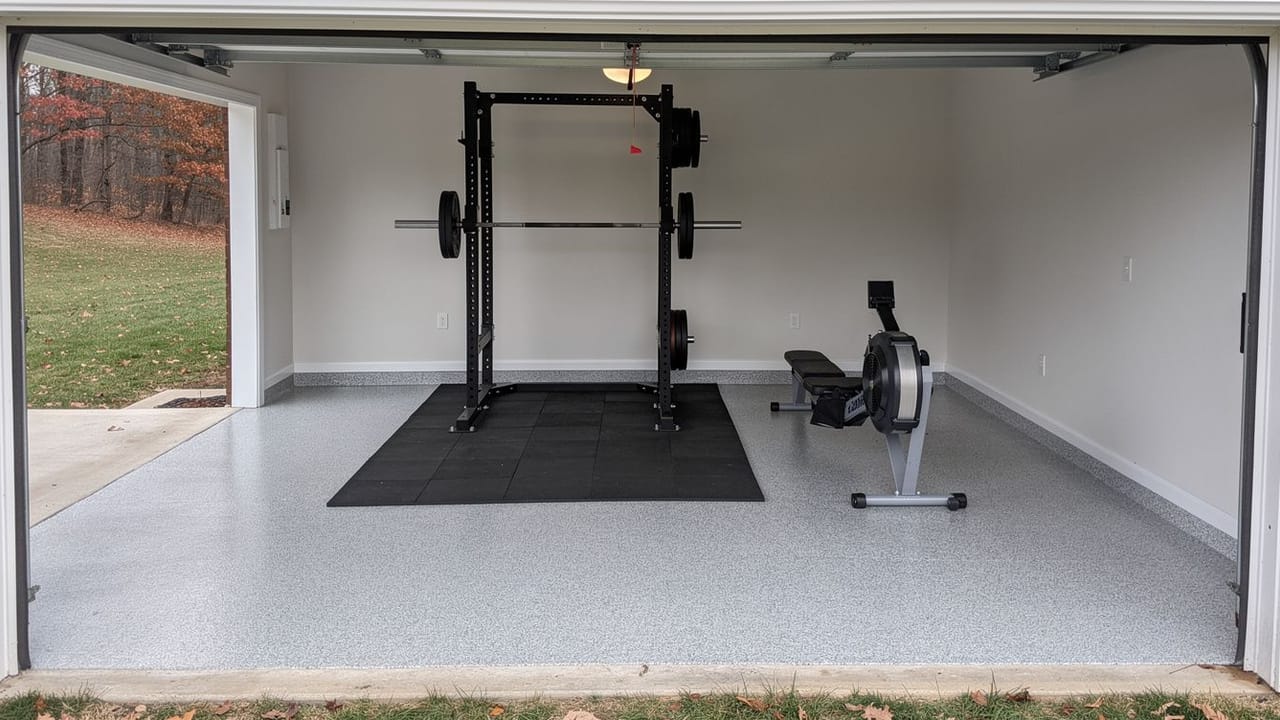
More of the garages we coat around Nashville are half parking space and half gym: a rack against the back wall, a bench, a rower or a bike, and a barbell that sometimes comes down harder than planned. Owners want to know two things before the coating goes down. Will it survive the gym, and should the mats go on top of it or instead of it.
The answer depends on what the coating is actually rated for, how thick the slab underneath is, and what happens to moisture under a rubber mat on a slab that may have no vapor barrier.
Can a garage floor coating handle a home gym?
A garage floor coating handles most of a home gym without any extra protection, and the one thing it cannot handle on its own is heavy weight dropped from height. Racks, benches, dumbbell stands, treadmills, rowers and bikes put steady weight on a few feet, and a properly bonded coating on a sound slab carries that the way it carries a parked car. Rolling a machine across it or sliding a bench is no different from the wear a garage sees anyway.
What changes the picture is impact. A barbell set down under control is fine. A bar dumped from the shoulders or the hips, or a kettlebell dropped from arm’s length, delivers a short, sharp blow to a small spot, and that is the load a coating is weakest against. So when we plan a garage floor coating for a room that doubles as a gym, we coat the whole floor and then talk about where the drop zone will be, because that spot needs something more than the coating.
What does a dropped weight do to an epoxy floor?
A dropped weight can crack or chip an epoxy floor at the point of impact, because the energy of a falling plate quickly exceeds what coatings are tested to absorb. Impact resistance on a coating data sheet is measured under ASTM D2794, which rapidly deforms a coated sample by impact and checks it for cracking. The Sikafloor 264 product data sheet, for a common floor epoxy, lists 26 ft-lb under that test.
Put that number next to a gym. Energy from a fall is weight times height, so a 45-pound plate dropped about seven inches carries roughly 26 ft-lb. A 135-pound bar falling three feet carries about 400, more than fifteen times the rating. ASTM itself says the method reproduces poorly between laboratories and that rankings are more reliable than the numbers, so a slightly higher figure on another brand’s sheet does not mean it will survive a dropped deadlift.
The slab matters too. Section R506.1 of the residential code as Nashville adopted it sets a concrete floor on the ground at no less than 3 1/2 inches thick, and many garage slabs are built close to that minimum.
Should rubber gym mats go on top of a coated garage floor?
Rubber mats belong on top of a coated garage floor wherever weights will be dropped, and nowhere else. Under a rack or on a lifting platform, thick rubber spreads the blow over a wider area and keeps the plate from reaching the coating at all. Across the rest of the floor, bare coating is easier to sweep, does not hold sweat or spilled water, and leaves the car side of the garage as it was.
The catch is moisture. The same section of the code that requires a 6-mil vapor retarder under a concrete floor on the ground lists garages among its exceptions, so many garage slabs were poured with nothing under them to stop ground moisture. A coating slows vapor coming up, but it does not stop condensation forming on a cool floor in humid weather, and a mat traps whatever collects. The EPA’s guide to mold and moisture in the home names the underside of carpets and pads as a place mold hides and recommends keeping indoor humidity below 60 percent. In a Middle Tennessee summer, a garage can sit well above that for weeks.
So we tell owners to lift their mats every few weeks in the humid months, wipe the floor dry, and let it air out before laying them back. If the mat maker publishes guidance on using its product over a coated floor, follow it.
Building the floor for a garage that is also a gym
Building a garage floor for gym use starts with the same preparation as any coating and adds a few decisions about texture and anchors. The slab is ground, not etched, so the coating bonds into sound concrete; cracks and pits are filled before anything goes down, which is the work on our concrete preparation page. For a gym we usually recommend a full-flake system, because the broadcast flake gives the surface texture underfoot and hides scuffs from equipment better than a solid color.
Traction is worth planning for, since sweat on a smooth topcoat is as slick as rain tracked in from the driveway. An anti-slip additive in the topcoat helps, and our post on whether a coated garage floor is slippery covers how much texture is enough.
If a rack will be bolted down, tell us where before we coat. Drilling through a finished coating is fine, but the anchors have to suit a slab that may be only 3 1/2 inches thick, and it is better to know that before the floor is done. Whether your garage is in Franklin or anywhere nearby, ask us for an estimate and we will walk the floor with your gym layout in mind.
Sources
- ASTM D2794-93(2019), Standard Test Method for Resistance of Organic Coatings to the Effects of Rapid Deformation (Impact) — The impact test behind coating data sheets; poor reproducibility between laboratories, rankings more reliable than numbers
- Sika, Sikafloor-264 Product Data Sheet — Impact strength 26 ft-lb under ASTM D2794
- 2024 International Residential Code as adopted by Nashville, Chapter 5, R506 — Concrete floors on ground at least 3 1/2 inches thick (R506.1); 6-mil vapor retarder required, with garages among the exceptions (R506.3.3)
- US EPA, A Brief Guide to Mold, Moisture and Your Home — Mold can hide on the underside of carpets and pads; keep indoor humidity below 60 percent
FAQ
A Garage Gym on a Coated Floor: What It Can Take — questions
Does epoxy flooring crack when you drop weights on it?
It can. A common floor epoxy is rated at 26 ft-lb of impact under ASTM D2794, about what a 45-pound plate carries falling seven inches. A loaded barbell dropped from the hips carries many times that and can chip or crack the coating at the point of impact. Rubber mats or a platform in the drop zone prevent it.
How thick is a typical garage floor slab?
The residential code Nashville has adopted sets a concrete floor on the ground at no less than 3 1/2 inches thick, and many garage slabs are poured close to that. That is why anchors for a squat rack should be chosen for the actual slab, and why heavy drops should land on mats rather than bare concrete.
Garage floor mats or epoxy for a home gym?
For most home gyms the answer is both. A coating covers the whole floor, cleans easily and leaves the parking side as it was. Thick rubber mats go only where weights get dropped, under the rack or on a platform, because a coating alone is not built to absorb a falling barbell.
Can moisture get trapped under rubber mats in a garage?
Yes. Many garage slabs have no vapor barrier, because the code exempts garages from that requirement, and condensation forms on cool floors in humid weather. A rubber mat holds that moisture against the floor. Lifting mats every few weeks in summer and keeping humidity under about 60 percent, as the EPA advises, keeps the floor dry.
Can you bolt a squat rack to a coated garage floor?
Yes. Anchors can be drilled through a finished coating into the slab. What matters is that the anchors suit the slab’s real thickness, which in a garage may be only about 3 1/2 inches. Telling your installer where the rack will go before the floor is coated avoids surprises later.