
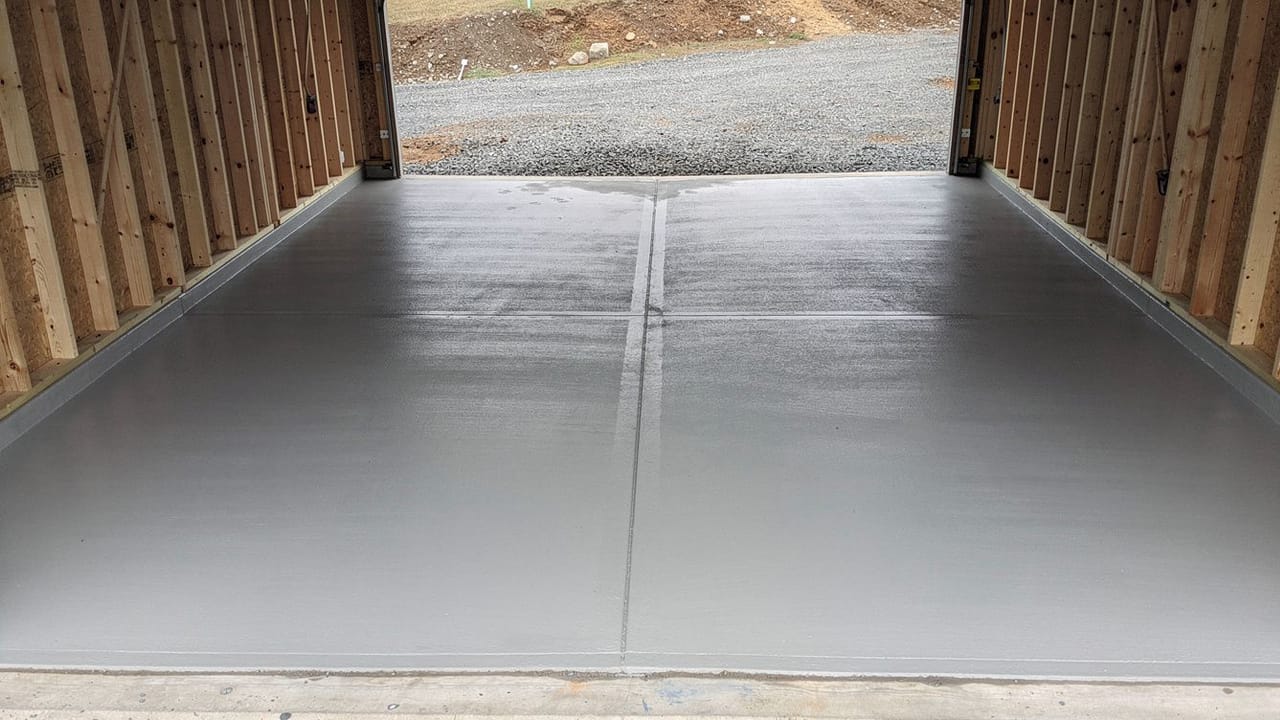
· by Michael Blair, Nashville's Garage Floor
Owners building a new house or a detached garage around Nashville often want the floor coated before the first car parks on it, so it only has to be done once. The question is how soon. The number most people have heard is 28 days, and it is a fair place to start counting, but it is not the day a slab is ready. This post is about new concrete only: why the calendar is a guideline, why a garage slab in particular can stay wet longer, and how we time an epoxy floor coating on a slab that was just poured.
How long should a new garage slab wait before it is coated?
At least 28 days, and longer if the moisture readings say so. Sherwin-Williams, in its technical article on coating freshly poured green concrete, says standard specifications recommend a minimum 28-day cure before an epoxy or other resinous coating, and calls that only a guideline: the real wait can be much longer depending on the concrete mix, the humidity, the air temperature and other conditions.
Curing and drying run on different clocks. Concrete gains strength as it cures, but a coating cares about the water still inside it. The National Ready Mixed Concrete Association’s CIP 28 on concrete slab moisture says most newly placed slabs cannot dry fast enough to meet flooring and coating makers’ moisture limits, and that drying to an acceptable level can take weeks to months even indoors in good conditions. It names what sets the pace: the water in the original mix, the type of concrete, the slab’s thickness, how it was cured, and the humidity and temperature from the pour to the day the floor goes down.
Sherwin-Williams adds that new concrete can look dry well before it is ready, and that different parts of the same slab can hold different amounts of moisture. A coating put down too early can seal that moisture in, and the article names bubbles and peeling as the result, the same failure our post on why garage floor coatings peel off traces back to the slab.
Does a garage slab have a vapor barrier under it?
Often not, because the residential code does not require one under a garage. Section R506.3.3 of the 2024 International Residential Code as adopted in Nashville, in the copy published by UpCodes, calls for a 6-mil polyethylene or approved vapor retarder, with joints lapped at least 6 inches, under a concrete floor slab. Its exceptions say the retarder is not required for garages, utility buildings and other unheated accessory structures. Metro Codes’ list of adopted codes shows the 2024 International Residential Code in effect in Davidson County; outside Metro, the county building office can tell you which edition applies.
So a retarder can be left out under a garage slab, and on some jobs it is. That matters for a coating because the ground under a slab is never dry. NRMCA says the relative humidity of the subgrade beneath a slab on ground measures close to 100 percent wherever the building is, and it recommends a vapor retarder directly beneath a slab that will get a moisture-sensitive floor, to keep moisture from moving up from below.
For a new build, the time to settle this is before the pour. If you plan to coat the garage floor, ask your builder whether a vapor retarder is going under the slab. The code lets a garage go without one; it does not stop you asking for one.
How do you know a new slab is dry enough to coat?
By testing it in more than one place against the limit the coating maker sets. Sherwin-Williams calls testing several areas the only valid way to tell whether a slab is ready, and our post on polished concrete, grind and seal, or a coating explains the in-slab humidity test we rely on, so we will not repeat it here.
One common test is weaker than it looks. NRMCA describes the plastic sheet test, ASTM D4263, where a square of plastic is taped to the slab and checked for moisture underneath, as qualitative: moisture under the sheet points to excess moisture, but a dry result does not show the slab is dry below the surface. We do not approve a new slab on a taped square of plastic.
Some products are made for wetter concrete. Sherwin-Williams says its moisture-tolerant and moisture-mitigating primers let some of its flooring systems go down on green concrete as early as 7 days after the pour. That is a manufacturer’s claim for its own products, and it holds only for the system it names, put down the way that system’s data sheet says.
What helps a new slab get ready sooner
Most of it happens between the pour and the coating. NRMCA advises against curing compounds on floors that will be coated unless the coating maker allows them, notes that moist curing adds drying time, and says to keep rain and construction water off the slab, because wetting it again lengthens the drying period. Once the garage is closed in, it says heat and dehumidifiers can speed drying.
Weather plays its part, since both NRMCA and Sherwin-Williams list temperature and humidity among the factors. A slab placed in a cool, damp stretch dries more slowly, and our post on coating a garage floor in cold weather covers the coating side of a cold season.
If you are building and want the floor done once, send us the pour date and whether a vapor retarder went under the slab, and we will plan the coating around readings rather than a date on the calendar.
Sources
- Sherwin-Williams, How Soon Can You Epoxy Coat Freshly Poured Green Concrete? — The 28-day guideline, testing several areas, primers for green concrete (manufacturer’s claim)
- National Ready Mixed Concrete Association, CIP 28, Concrete Slab Moisture — Drying takes weeks to months; subgrade humidity near 100 percent; curing compounds; the plastic sheet test
- Nashville and Davidson County 2024 International Residential Code, R506.3.3 Vapor Retarder (UpCodes copy) — The vapor retarder rule and its exception for garages
- Metro Nashville Codes Administration, Adopted Codes List — Metro’s adoption of the 2024 International Residential Code
FAQ
How Long a New Garage Slab Waits Before Coating — questions
How long should concrete cure before epoxy?
Standard specifications recommend at least 28 days, according to Sherwin-Williams, which calls that a guideline. The slab also has to dry, and the National Ready Mixed Concrete Association says new slabs can take weeks to months to reach coating makers’ moisture limits. A moisture test in several places, not the calendar, decides.
Can you epoxy new concrete?
Yes, once it has cured and dried enough to meet the coating maker’s moisture limit. Coating too soon can trap moisture and cause bubbles or peeling. Some makers sell moisture-tolerant primers for green concrete; Sherwin-Williams says some of its systems can go down as early as 7 days after the pour.
How soon can you coat a new garage floor?
Plan on no less than 28 days after the pour, then test. A garage slab may have no vapor retarder under it, since the residential code excepts garages, so it can keep drawing moisture from the ground. We coat when readings in several spots meet the coating maker’s limit for the chosen system.
Why does new concrete need testing before it is coated?
Because it can look dry long before it is. Sherwin-Williams says moisture can vary across a single slab and that testing several areas is the only valid way to know. A coating sealed over a slab that is still wet can bubble or peel, so we test before any coating goes down.
Does the code require a vapor retarder under a garage slab?
Not in Nashville. Section R506.3.3 of the 2024 residential code Metro adopted requires a 6-mil polyethylene or approved retarder under concrete floor slabs, but its exceptions include garages, utility buildings and other unheated accessory structures. The retarder can be left out there, though nothing in the code forbids putting one in.