
· by Michael Blair, Nashville's Garage Floor
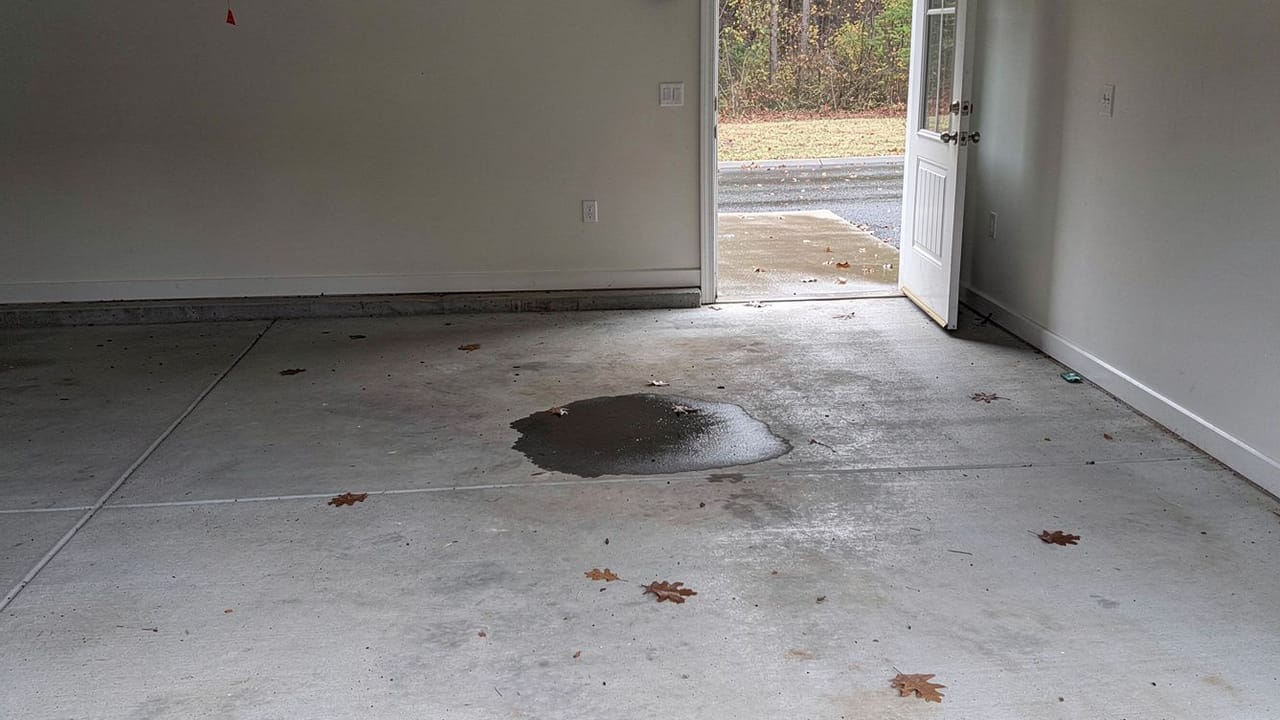
Nearly every garage we look at has one: a dark patch under where the car has parked for years, sometimes two, sometimes a trail of drips toward the door. Owners planning a coating tend to treat it as cosmetic, something the new color will cover. It is the opposite. Concrete is porous, so the oil is in the surface, not sitting on it, and a coating bonds to that surface. Our post on why garage floor coatings peel off lists oil among the common causes. This one is about the oil itself: what it does under a coating, how it comes out, in what order, and what happens to the rinse water around Nashville before an epoxy floor coating goes down.
What does oil in the slab do to a new coating?
It keeps the coating from bonding, which is why coating makers require concrete free of oil before their product goes on, and they describe what happens when it is not. Sika’s installation guide for the Sikafloor-200 Garage Epoxy Kit, a Canadian sheet for a do-it-yourself epoxy, warns that oil left in the concrete leads to surface tension separation, poor adhesion, black spots and wet patches that do not cure. In plain terms, the epoxy pulls away from the oily area while it is still liquid, fails to grip where it does lie, and may never harden over the spot.
Industrial products say the same. Rust-Oleum’s technical data sheet for its 6700 System 100% solids epoxy requires concrete free of dirt, grease, oil, fats and other contamination, and on existing floors it adds that concrete must be clean and sound. Both are epoxy instructions. For a polyaspartic system we follow that maker’s own preparation sheet, and the stain still comes out first.
How do you get oil out of a concrete garage floor?
With a concrete degreaser, scrubbed in and rinsed off, before any grinding starts. The Sika guide says oil and grease stains can be removed with a commercially available concrete degreaser used by its printed instructions, and the Rust-Oleum sheet names a cleaner degreaser, detergent or another suitable cleaner, followed by a thorough rinse with clean, fresh water and time to dry.
The order matters as much as the product. Sika’s guide says oil and grease must be removed before sanding, to keep the contaminant from spreading across the whole surface. The same holds for diamond grinding: a grinder run across an oily parking spot can carry that oil into clean concrete beside it. So on our jobs the stained areas are degreased and rinsed first, and the grinding that opens the slab for the coating comes after. An old, deep stain can take more than one round, and we tell the owner if a shadow is likely to remain under a solid color.
How long does a garage floor need to dry after degreasing?
Long enough that the slab is dry all the way through its surface, which takes far more time than it looks. Sika’s guide warns that if water is used to rinse, the concrete needs ample time to dry fully before further preparation or coating. Its moisture check is simple: tape an 18 by 18 inch sheet of polyethylene to the floor and wait at least 24 hours. Condensation under the plastic or a darker patch of concrete means there is too much moisture to coat, and the test is run again after more drying.
That test is Sika’s for its own epoxy, and other coatings name their own limits, but the idea carries over. A floor that was just scrubbed and rinsed is not ready the same afternoon, however dry it feels underfoot. We plan the degreasing a day or more ahead of grinding and coating so the slab has that time.
Where the rinse water goes in Davidson County
A garage floor drains to the driveway, and the driveway drains to the street. Metro Code 15.64.205, published on Metro Water Services’ illicit discharge ordinance page, prohibits non-stormwater discharges into the storm sewer system, and its definition of that system includes streets, curbs, gutters and storm drains. The ordinance lists the discharges it allows, among them lawn watering and individual residential car washing. Washing a garage floor or a driveway is not on that list. The civil penalty runs from fifty to five thousand dollars per day of violation.
So we do not hose degreaser rinse out the garage door. The water is kept on the slab, picked up with a wet vacuum and disposed of properly, and the floor is left to dry. If you are planning a coating in Nashville and Davidson County and have an old oil spot or two, ask us for an estimate and point out the stains when we visit, so the degreasing and drying time are in the schedule from the start.
Sources
- Sika Canada, Sikafloor-200 Garage Epoxy Kit installation guide — Concrete free of grease and oil; degreaser per its instructions; remove oil before sanding so it does not spread; ample drying after a water rinse; plastic sheet moisture test of at least 24 hours; oil left causes separation, poor adhesion, black spots and uncured patches (epoxy product)
- Rust-Oleum, 6700 System 100% Solids Decorative Epoxy technical data sheet — Surface free of dirt, grease, oil, fats and contamination; clean with a cleaner degreaser or detergent; rinse with clean water and let dry; existing concrete clean and sound
- Metro Nashville, Metro Code 15.64.205 Non-stormwater discharges, on the Metro Water Services illicit discharge ordinance page — Non-stormwater discharges to the storm sewer system prohibited; the system includes streets, curbs, gutters and storm drains; allowed list includes lawn watering and individual residential car washing; civil penalty of fifty to five thousand dollars per day
FAQ
Oil Stains on a Garage Floor Before a Coating — questions
Will epoxy stick to an oil-stained floor?
Not reliably. Sika’s instructions for its garage epoxy kit say oil left on concrete causes surface tension separation, poor adhesion, black spots and wet, uncured patches. The coating may pull back from the stain while wet and later lift from it. The oil has to be removed with a degreaser before the floor is ground and coated.
How do you clean a greasy garage floor?
Scrub in a concrete degreaser, following its label, then rinse with clean water and pick the rinse up. Do this before any sanding or grinding, because Sika’s guide warns that grinding an oily area spreads the oil across the rest of the floor. Old, deep stains may need more than one round of degreasing.
What should you use to clean a garage floor before epoxy?
A concrete degreaser on oil and grease, and a detergent or suitable cleaner on general dirt, as coating makers such as Sika and Rust-Oleum describe. Rinse thoroughly with clean water, let the slab dry completely, and then grind it, because cleaning removes contamination but does not give the concrete the profile a coating needs.
Can you wash a garage floor into the street in Nashville?
Not under Metro’s stormwater rules. Metro Code 15.64.205 bans non-stormwater discharges to the storm sewer system, which includes streets, gutters and storm drains. Its list of allowed discharges includes lawn watering and residential car washing, but not floor or driveway washing. Penalties run from fifty to five thousand dollars a day.